AI is changing how software is built and sold, but not what makes companies defensible.
This month, SpaceX agreed to acquire Cursor for $60 billion. OpenAI picked up two dev-tool startups since March. The AI coding wars have become the biggest M&A story in software, and the companies getting acquired were mostly unknown eighteen months ago.
Rewind to February, and the picture looked very different. The launch of autonomous agents for legal work triggered a selloff across enterprise software stocks that wiped out roughly $285 billion in market capitalization in a matter of days. Investors began asking a fundamental question: what happens to software companies when AI replaces the users they charge for? For decades, software companies sold licenses tied to the number of users. If AI agents replace employees, customers buy fewer licenses and the revenue model starts to crack. This is what industry analysts called the “SaaSpocalypse.”
It’s easy to see why investors got spooked. But the selloff misses something important. Software is being monetized differently in the age of AI. The numbers bear this out: AI-native software spending among mid-market and enterprise companies grew 94% year-over-year, while traditional SaaS grew just 8%, according to a 2025 report from procurement platform Tropic. Software is still creating enormous value, but more of that value is flowing to companies that are using AI to build on existing advantages. So while AI may cut down the cost and time needed to build new products, it doesn’t change the reasons why some companies succeed and others don’t.
That value isn’t coming from the software alone, but from what the software becomes over time. The longer a system of record is the underpinning of how people work, the harder it is to rip out. And some tools get more valuable simply because more people are already using them: the bigger the network, the harder it is for a newcomer to compete.
The payoff may be substantial. We’re seeing that AI-native companies are reaching revenue targets more quickly than earlier software companies. This is happening because AI is expanding the total addressable market beyond traditional software budgets. Some of that growth comes from entirely new categories of software spending, such as developer tools like Cursor. AI products that perform work previously done by people are also a major contributor.
The race to $100 million
Let’s put this in context: by its 10th anniversary in 1985, Microsoft crossed $100 million a year in revenue. Google, founded in 1998, was doing roughly $86 million in annual revenue by 2001 and around $440 million by 2002.
AI-native leaders reached similar milestones far more quickly. Cursor went from roughly $1 million to $100 million dollars in ARR in about 12 months, according to Sacra. Lovable surpassed $100 million in ARR just eight months after its first million; and Wiz scaled from $1 million to $100 million in ARR in 18 months.
To be sure, this comparison isn’t exactly apples-to-apples. Microsoft’s and Google’s numbers reflect audited revenue, while most of the AI-native figures are ARR run rates from a different era. But it still represents a bigger shift. AI-native companies have a different economic model: they require little or no onboarding and can reach users directly without going through enterprise procurement. They often charge per unit of work instead of by employee seat, so when usage goes up, revenue grows with it. Unlike traditional SaaS, growth isn’t necessarily tied to getting more users.
This growth velocity is driving some of the biggest deal activity in tech:
- SpaceX will acquire Cursor for $60 billion after the company went from $1 billion in ARR in November 2025 to $4 billion by June 2026.
- Cognition acquired the AI-powered coding editor Windsurf in July 2025. The company had reached $82 million in ARR with enterprise ARR doubling quarter-over-quarter, after a $3 billion OpenAI bid collapsed and Google hired away the CEO and co-founders for $2.4 billion.
- OpenAI acquired dev-tool startups Astral (March 2026) and Ona (June 2026), embedding coding infrastructure into its core platform.
So what’s happening here? Companies drawing billion-dollar bids are charging for what gets done and growing without a traditional sales force. That’s the model Great North Ventures is investing behind: vertical AI that embeds into existing workflows and charges for outcomes, not seats. Financial services built into those workflows follow the same logic. For example, a payments feature or a lending product doesn’t need a separate sales motion. It grows the same way the software does.
AI makes building easier, but defensibility still wins
Everybody knows AI has made it cheaper and faster to build software than at any point in history. But if you can ship a product in weeks, so can the team that wants to copy it. The companies that win aren’t just the ones that move fast; they’re the ones that build something competitors can’t easily replicate.
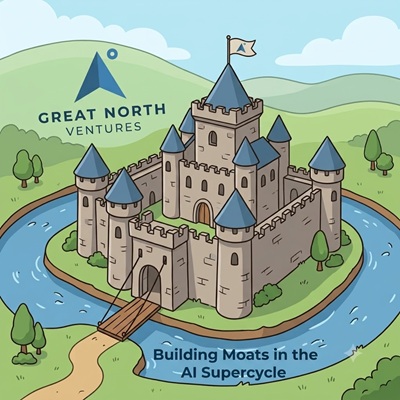
At Great North Ventures, we evaluate software not by what it builds — but by what makes it hard to dislodge. Strategist Hamilton Helmer’s 7 Powers framework is instructive here. The three drivers most relevant for software are switching costs, network economies (what most people in software just call network effects) and scale economies. Leaving gets expensive for customers when the switching costs are high. The product gets more valuable as more people use it when network effects kick in. And the bigger you get, the cheaper it is to serve the next customer when scale economies are at work. AI doesn’t change any of this, because cheaper building doesn’t erase these advantages. It just widens the gap between companies that have them and companies that don’t.
Network effects are easy to see in action. For example, if someone copied a dominant social platform’s source code and launched it tomorrow, nobody would leave the original. This is because the value is everything underneath the code: the relationships, habits, data and trust that comes from millions of interactions.
Take Visa and Mastercard, for example. AI-native startups can build faster and cheaper, but they still face the same hurdle every new challenger has faced. Merchants need to accept a payment method before consumers will adopt it. The more merchants accept it, the more consumers want it. The network compounds over time.
Switching costs work the same way. Great North Ventures portfolio company CapitalOS, founded in 2022, is a financial engine embedded into other software. CapitalOS uses AI to automate expense-management workflows and support underwriting decisions, and it now runs inside dozens of vertical software platforms, each with its own set of small-business customers and data that helps strengthen underwriting. This makes it harder to rip out with every new integration. So when a business app wants to offer its users charge cards, bill pay, or expense management, it embeds CapitalOS rather than become a financial institution itself.
A better AI model can improve the underwriting algorithm, but it doesn’t threaten CapitalOS. No model can provide bank relationships, compliance infrastructure or integrations that dozens of companies already rely on.
Of course, not every company that looks defensible today will hold up over time. Data that’s easy to extract, interfaces that are easy to copy, workflows that are easy to recreate can all turn what looked like an advantage into something more vulnerable than it initially seemed.
The math still works, though the pricing logic has evolved
AI is changing software economics, not the foundations of value creation. For years, the unit of value was the seat: a person logged in and the vendor charged for a per-seat fee. Now, when the model does the work, the output is the unit, not the user. The customer pays for the end result, or the task.
With AI-native businesses, customers spend far more on getting work done than on software licenses. AI-native companies that charge against the labor budget — not the IT budget — are competing for a fundamentally bigger pool of spend. A 2026 survey of 230 B2B software and AI companies found that hybrid usage- and outcome-based pricing is now the most popular model, up from 25% adoption to 37% in just one year.
Harvey, an AI platform for legal work, is a proof of concept. Customers buy it to replace costly legal labor performed by associates and paralegals. The result: $190 million ARR in just over 36 months and a valuation of $11 billion in three and a half years since its founding. There’s also a built-in moat: only companies with real customers and demonstrable results can credibly charge for outcomes.
Fintech infrastructure has a long runway in the AI era
The SaaSpocalypse is a bigger threat to firms that sell seats than to companies that sell infrastructure. B2B fintech largely falls into the latter category. Morningstar’s analysis of more than 130 companies found that the strongest moats in the AI era are built around “infrastructure, proprietary data, network effects, or specialized domain workflows.”
The market has already repriced horizontal SaaS; major public companies like Salesforce, Adobe, and Workday saw valuation multiples fall 30–50% between early 2025 and early 2026, with the private market median settling near 3.4x revenue as of March 2026, according to Aventis Advisors. Fintech tells a different story. Banking infrastructure and embedded finance platforms are commanding 8–15x revenue, with top-tier AI-enabled businesses reaching 10x and above, according to Windsor Drake’s 2026 fintech valuation data. This gap reflects what investors actually think about revenue quality, retention and competitive durability.
Embedded finance, financial products woven into the software businesses and consumers already use, is projected to reach a market size of $7.2 trillion by 2030. The companies best positioned to benefit aren’t always the ones that move fastest, but those that have built the regulated infrastructure to support it. Better models can improve underwriting and fraud detection, but they can’t recreate years of work building bank partnerships and navigating regulatory requirements.
The bigger picture
The SaaSpocalypse thesis assumes that as AI makes software easier to build, software companies will become less valuable. We see it differently: AI is changing the economics of software, but not the factors that determine who wins.
Companies that succeed still need to earn customer trust and embed themselves in workflows. They also need strong customer relationships. Those advantages take years to build and are hard to replicate, regardless of how powerful the models become.
If anything, AI makes these advantages more valuable. As the barriers to building software fall, differentiation is moving away from the software itself and toward the assets competitors can’t easily copy: trust, data, workflow integration and network effects. Incumbents that are the most exposed are the ones the market cannot yet tell apart from companies built with real defensibility. That uncertainty is exactly why the discount is so steep. At the same time, many of the companies building those durable advantages are still private, before those differences are fully reflected in market valuations.