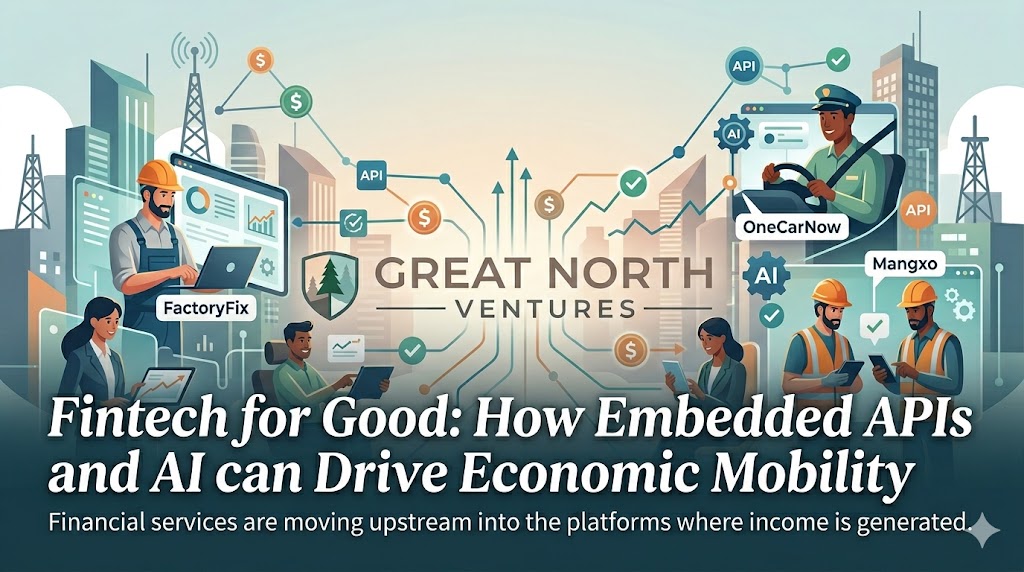
Financial services are moving upstream into the platforms where income is generated.
Tens of millions of Americans face a major hurdle in achieving financial self-sufficiency. These individuals can’t be easily underwritten by traditional risk scoring systems. This means they can’t rent an apartment, qualify for a small business loan, or build credit history. According to the Federal Reserve, about 32 million Americans are considered unscorable. This group includes people who are credit invisible as well as those with thin credit files.
Globally, approximately 1.3 billion adults are unbanked, per the World Bank’s 2025 Global Findex report.
Traditional financial institutions and credit systems weren’t built to serve these populations, but a new generation of embedded fintech platforms is changing that. Embedded APIs and AI-driven underwriting are transforming the infrastructure of economic access. They allow startups to assess borrowers based on cash flow instead of credit history and deliver financial tools directly to workers and small business owners who have been shut out of the traditional system.
This is a field Great North Ventures has long been focused on: companies where expanding access and building durable businesses go hand in hand.
How API-driven connectivity opens up opportunities
Historically, offering a financial product like a loan, a bank account, or a payment card required a banking license, compliance infrastructure, and years of regulatory groundwork. Embedded finance APIs change that. An API, or application programming interface, is a software connector that lets two platforms share data and functionality in real time. Think of how Uber pays its drivers instantly after a trip. The payout doesn’t go through traditional bank infrastructure; it flows through an API connecting Uber’s platform to its payments provider.
Through APIs, any software platform like a gig marketplace, a payroll system, or a construction app can offer financial services natively inside its existing product without becoming a bank.
What does this mean for the tens of millions of Americans who are unscorable? A construction worker’s payroll app can now offer a small business loan. A gig platform can offer a bank account. A workforce marketplace can provide earned wage access. Financial services can follow people into the platforms where they already work and earn, rather than waiting for them to walk into a bank branch they may never qualify to use.
APIs enable distribution, getting financial services to underserved borrowers. Meanwhile, AI solves the assessment problem, figuring out who is creditworthy, even if they don’t have sufficient credit history.
The AI layer replaces the traditional credit score with real-time signals such as earnings history, payment patterns, cash flow, and platform-specific behavioral data, opening access to borrowers traditional lenders cannot underwrite. The result is a new class of lender with a more direct and continuous view of borrower risk than any credit bureau. For investors, the combination of structural cost advantage, proprietary data and a large underserved market is where durable businesses are built.
The Infrastructure Layer: LendAPI
Before any fintech can reach underserved populations, the underlying infrastructure needs to be developed. That’s the role LendAPI plays. LendAPI’s platform turns complex compliance, KYC/KYB, and loan origination into turnkey workflows for embedded lending, neobank stacks, healthcare finance and vertical SaaS. What would previously take years of regulatory groundwork and engineering can now be stood up in weeks.
Think of it as the ‘GoDaddy of lending,’ the same way GoDaddy let anyone launch a website without building server infrastructure. LendAPI lets any fintech launch a lending product without building a bank. That matters for economic mobility because it democratizes the infrastructure of credit, lowering the barrier for any startup to serve underbanked communities.
Workforce mobility: FactoryFix and Branch
For gig workers, the barriers to financial stability often start before the first paycheck.
FactoryFix is a labor marketplace that connects manufacturing businesses to vetted industrial professionals, including engineers, automation specialists, and maintenance crews. For skilled workers who are often invisible to corporate hiring pipelines, it opens a direct path to quality employment. Its AI screens, scores, and engages candidates automatically, cutting time-to-hire by 40% and reaching workers that traditional hiring pipelines routinely miss.
Getting hired is only the first step. Branch uses embedded finance APIs to deliver financial tools — fee-free bank accounts, earned wage access, and financial wellness products — directly inside the gig and workforce platforms workers already use, rather than requiring them to seek out a separate bank.
The API advantage here is structural: financial services are embedded at the point of income. Branch has processed more than $23 billion in worker payments through this model. Nearly 80% of workers say they would switch platforms for instant, no-fee payouts, signaling clear demand. For workers living paycheck to paycheck, faster access to earnings is not marginal. It directly affects financial stability.
Capital Access Beyond Borders: OneCarNow (OCN) and Mangxo
The same thesis that applies to gig workers in the U.S. applies in emerging markets, where the credit infrastructure gap is far larger.
OCN is a clear example of AI underwriting displacing traditional credit scores. Fewer than 3% of ride-hail drivers in Latin America qualify for conventional auto loans, leaving a large, underserved market. OCN uses platform data, including earnings, trip volume and reliability metrics, to assess borrowers that traditional lenders cannot underwrite. It doesn’t just underwrite the loan: it provides the vehicle, bundles in insurance and maintenance, and structures payments as a rent-to-own arrangement, so a driver who has never qualified for credit can build toward ownership for the first time. The company has maintained a consistent single-digit default rate over the past two years.
Mangxo extends the same logic to construction supply chains in Mexico, providing material suppliers with an online credit tracking system that lets them offer flexible, interest-free credit to subcontractors. The industry has historically operated on pen and paper with almost no formal financial infrastructure.
These examples show how AI-driven underwriting and API-based distribution are unlocking access to financial services in underbanked markets. These are the regions with the largest infrastructure gaps, and where embedding financial products directly into income streams can drive the most meaningful and compounding economic impact for underserved populations.
The investor case
Great North Ventures’ focus on vertical AI and embedded finance reflects a structural bet aligned with the outcomes mission-driven capital is designed to support. These technologies are expanding access to credit, income, and financial tools for populations long excluded from traditional systems, linking financial performance with measurable economic opportunity.